Energy Disruption Is Spreading Into Freight and Credit
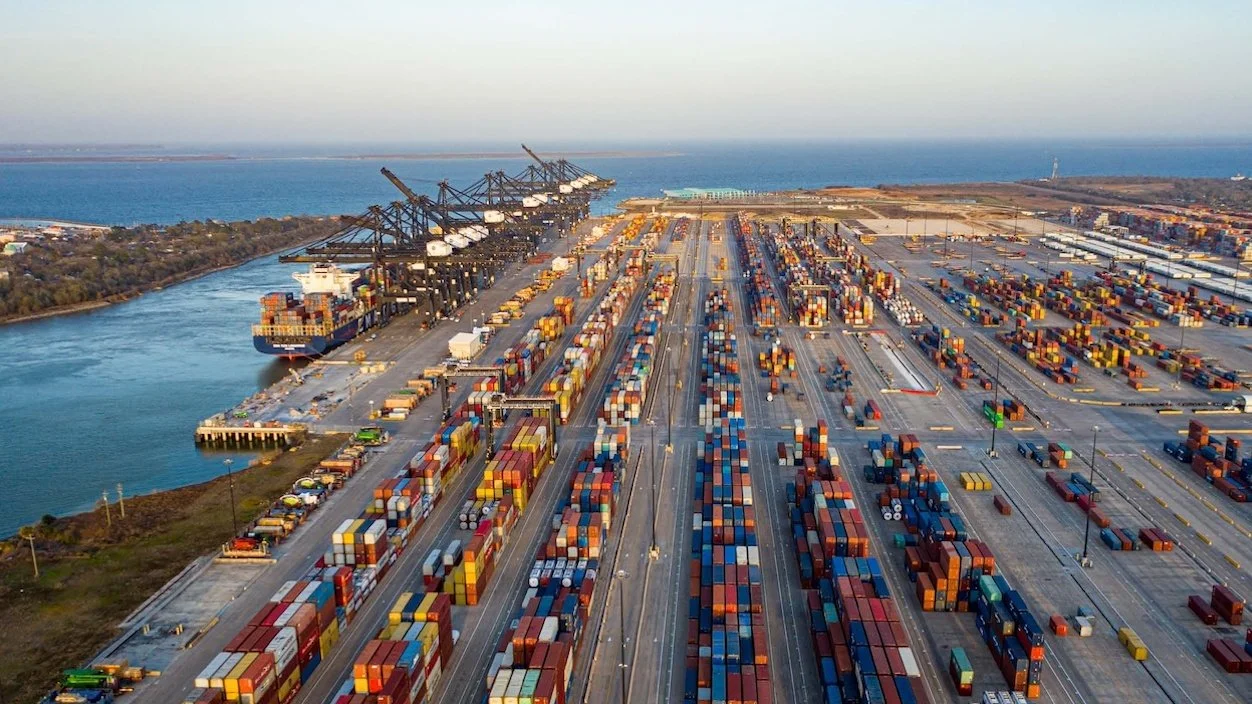
Container operations at the Port of Houston. Rising fuel and shipping costs are carrying the effects of energy disruption farther into U.S. freight and distribution networks.
The damage to Saudi Arabia’s East–West Pipeline is more extensive than initially reported.
When the pipeline was attacked on September 13, early reporting indicated that two pumping stations had been damaged. Satellite imagery reviewed by Reuters now shows damage at three. Three industry sources estimated that full repairs could take five to six weeks, although partial operations may resume sooner. That is substantially longer than the “days” suggested by U.S. Energy Secretary Chris Wright on September 15. Saudi authorities had not provided a detailed public repair schedule as of Reuters’ September 17 report.
The pipeline is important because it is one of Saudi Arabia’s primary alternatives to the Strait of Hormuz. It carries crude from production areas in the east of the country to the Red Sea, allowing those exports to avoid the strait. With traffic through Hormuz already constrained by the war with Iran, roughly 4 to 5 million barrels per day had been moving through the East–West line.
That was the basis for the September 13 Risk Monitor analysis, The Backup Routes Are Failing, which focused on the simultaneous exposure of routes that normally provide redundancy for one another. Hormuz was under pressure, fighting in Yemen was moving closer to Bab el-Mandeb, and the East–West Pipeline had been damaged while serving as an alternative to Hormuz.
The new evidence strengthens that assessment. There is more damage to the pipeline than was known five days ago, and the possible repair period is longer.
But several developments since then also show how the disruption is moving beyond the physical energy network. Shipping costs have increased sharply. U.S. diesel prices have continued rising. The Federal Reserve has raised interest rates for the first time in more than three years. Household expectations around credit and financial conditions were already deteriorating before that increase.
These are not independent indicators anymore, as the same disruption that has reduced physical redundancy in the energy system is increasing transportation costs while the cost of financing those increases is also rising.
Shipping is absorbing the disruption, at a higher cost
Saudi Arabia has not lost the ability to export oil.
It has continued selling crude through other arrangements, including additional loadings from inside the Persian Gulf. Oil prices fell on September 17 as markets became somewhat more confident that Saudi supply would continue reaching buyers despite the pipeline outage.
Commercial shipping is also continuing. But the price of maintaining those flows has increased substantially.
Reuters reported on September 17 that the spot rate for a forty-foot container from China to the U.S. East Coast had reached $10,948, more than four times its level at the beginning of the Iran war. Analysts said rates could approach or exceed pandemic-era records if fuel costs remain elevated.
Oil shipping has been affected even more directly. Rates for very large crude carriers reached record levels after attacks on commercial shipping increased security and insurance costs and disrupted normal routing. Marine fuel costs have also risen.
Some of those costs are now visible inside the United States.
The Energy Information Administration reported that the national average price of diesel reached $6.285 per gallon on September 14. It was $5.348 at the beginning of August and $3.897 in early March. Regular gasoline reached $4.319 nationally.
Diesel has broader economic effects than the price paid by drivers who own diesel vehicles. It is used throughout freight transportation, agriculture, construction and distribution. Higher diesel prices therefore increase operating costs across supply chains that were already facing higher maritime freight costs.
There is no fixed relationship between those increases and consumer prices yet. Businesses can absorb some costs through lower margins, and they can change suppliers, reduce inventory, postpone purchases or increase prices. Freight rates and fuel prices can also fall quickly if the underlying disruption improves.
For now, however, the direction is consistent across several parts of the transportation system: maintaining the movement of energy and goods has become more expensive.
Financing conditions are tightening at the same time
On September 16, the Federal Open Market Committee raised the federal funds target range by 25 basis points to 3.75–4.00 percent. It was the first rate increase since July 2023.
In June, the median FOMC participant projected a federal funds rate of 3.8 percent at the end of 2026 and 3.6 percent at the end of 2027. In September, both projections moved to 4.1 percent.
The Fed also raised its median projection for 2026 PCE inflation from 3.6 to 3.7 percent and core PCE inflation from 3.3 to 3.4 percent.
At the same time, the Fed increased its expected 2026 GDP growth rate and lowered its unemployment projection. Those forecasts are not observed outcomes or independent assessments of the economy. FOMC participants make them using their own assumptions about appropriate monetary policy and how the economy will respond to it, so they are more useful as evidence of how policymakers currently understand the economy and the effects they expect their decisions to have than as evidence that those outcomes will actually occur.
The rate increase therefore should not be read as evidence that the Fed believes the energy disruption itself can be corrected through monetary policy. Interest rates cannot restore the East–West Pipeline or increase shipping capacity.
The Fed's decision appears to reflect concern about what happens if higher energy and transportation costs spread into broader inflation. If businesses and households begin expecting higher prices to persist, those expectations can affect wages, contracts, spending and pricing decisions. Monetary tightening is intended to reduce that risk.
It also increases borrowing costs, as major U.S. banks raised their prime lending rates from 6.75 to 7 percent following the Fed decision, while the 10-year Treasury yield was around 5 percent this week.
Businesses facing higher fuel or freight costs may absorb them through lower margins, pass some of them on through higher prices, or reduce activity where the additional expense makes existing operations less viable. Credit can help bridge a period of unusually high costs or allow businesses to carry inventory until conditions improve, but borrowing becomes a more expensive way to create that room as interest rates rise.
The same applies to households, where higher prices can be absorbed through income, savings, reduced consumption or borrowing. Credit can delay or distribute financial stress rather than eliminating it, and tighter credit conditions reduce the flexibility households have to use it that way.
There was already evidence of weakening household expectations before the September rate increase.
The Federal Reserve Bank of New York’s August Survey of Consumer Expectations found that the perceived probability of finding another job after losing one had fallen to 45.4 percent. The share of respondents reporting that credit was harder to obtain increased, expectations for future credit availability deteriorated, and the perceived probability of missing a minimum debt payment during the next three months rose to 13.2 percent.
Households also reported worse assessments of their current and future financial situations.
The survey does not show that those outcomes have occurred. Some labor measures were also stronger, as perceived job-loss probability declined slightly and expected quits increased.
The survey establishes that additional energy and transportation costs are arriving while households already report less confidence in employment replacement, credit access and their financial position.
The Fed’s rate increase adds another source of pressure to that existing condition.
Public capacity is also being used to manage the conflict
The federal government is absorbing part of the same disruption through military spending.
On September 15, the Congressional Budget Office estimated that Department of Defense combat operations against Iran had cost approximately $38 billion through August 1. CBO estimates that another month of fighting at recent levels could add roughly $2 billion to $3 billion, with higher costs possible if operations intensify.
Those estimates don't include every federal cost associated with the conflict, and CBO cautions against simply adding all of its cost categories together.
The important point for this analysis is that public resources are being used at the same time private systems are adapting to the economic consequences of the conflict.
That is not inherently evidence of deteriorating state capacity. Governments maintain fiscal and military capacity specifically so that they can respond to emergencies. However, the question is how much capacity is being used, for how long, and whether additional demands begin arriving before existing ones have receded.
PJM Interconnection activated pre-emergency and emergency demand-response resources as unusually warm September weather coincided with generation and transmission outages. The Department of Energy also issued an emergency order under Section 202(c) of the Federal Power Act after PJM requested additional authority.
Demand response allows participating customers to reduce electricity use when grid conditions become tight, creating additional operating margin without requiring an equivalent amount of new generation.
It worked, as there was no reported blackout. PJM subsequently said it did not expect emergency conditions to continue beyond September 17.
The event therefore wouldn't support a claim that the PJM grid is failing. It shows that the system encountered conditions sufficient to require resources normally held in reserve, and those resources successfully absorbed the stress.
That is relevant to the broader assessment because the same distinction applies to the energy and economic systems currently under pressure.
Saudi Arabia still has other ways to get oil to market, and shipping companies have kept cargo moving by rerouting vessels and taking on higher fuel, insurance and security costs. Those costs then have to be absorbed somewhere else, whether that's by businesses through margins, inventories or prices; by households through changes in spending, or through additional borrowing. Government spending and monetary policy sit farther downstream, responding to consequences that the physical energy and shipping systems haven't been able to eliminate.
The existence of those responses is evidence that compensatory capacity remains available.
What has changed since the September 13 analysis
The Backup Routes Are Failing focused primarily on physical redundancy in the energy and maritime system, and that assessment has strengthened.
The known damage to the East–West Pipeline increased from two pumping stations to three, and industry estimates now suggest full repairs may take several weeks. Pressure at Hormuz therefore remains important while one of the principal alternatives around it is operating with reduced capacity.
What has changed since September 13 is the evidence farther downstream.
Container shipping costs have increased sharply as tanker rates reached records. U.S. diesel prices have risen above $6 per gallon nationally. The Federal Reserve has resumed monetary tightening and raised its expected policy-rate path. Major banks immediately raised their prime rates, and household expectations around credit access and financial conditions had already weakened before the rate increase.
None of those developments proves that the original supply disruption will produce a broader economic crisis yet. But they do show that several mechanisms used to absorb the disruption are now interacting.
Higher shipping costs can be absorbed through margins, prices or financing. Higher fuel costs can be absorbed through the same channels, while higher interest rates make financing more expensive. Households facing higher prices have less flexibility if credit becomes harder or more expensive to obtain. U.S. government intervention can offset some private-sector pressure, but that uses fiscal and administrative capacity.
The current concern is therefore no longer limited to whether enough oil can physically reach the market. We're now tracking whether the economic systems that compensate for reduced physical capacity are also becoming more constrained.
So far, they are still functioning.
What I’m watching now
The first indicator is actual throughput on the East–West Pipeline. Partial restoration would return some capacity around Hormuz even before repairs are complete. A rapid restoration would weaken this assessment, while continued delays, additional damage or lower-than-expected throughput would strengthen it.
The second is the relationship between crude prices and downstream transportation costs. If crude prices fall and diesel, marine fuel, tanker rates and container freight follow, that would indicate that current pressures are beginning to unwind. If crude stabilizes or falls while those downstream costs remain elevated, the disruption will have become more persistent inside transportation and distribution networks.
Credit conditions are the next indicator. The September rate increase changes the price of borrowing, but it does not establish that businesses or households have lost access to credit yet. Lending standards, delinquencies, high-yield spreads, revolving-credit use and small-business borrowing conditions will show whether higher rates are materially reducing the ability to absorb other costs.
I am also watching household data for confirmation or contradiction of the August New York Fed survey. Realized increases in delinquencies, unemployment or financial distress would strengthen the assessment, while improving job-finding expectations, easier credit conditions or stronger household balance sheets would weaken it.
PJM should be treated as a separate but relevant capacity indicator. One September demand-response activation is insufficient to establish a broader grid trend. But repeated emergency actions during shoulder seasons, particularly when they coincide with other infrastructure constraints, would be more significant. A return to normal operations would indicate that the September 17 event was successfully contained.
Finally, I am watching for additional cases in which one compensatory mechanism depends on another that is already under pressure. Freight costs combined with tighter business credit are more significant than either development separately. Higher household prices combined with weaker credit access would be more significant than higher prices alone. Additional federal emergency spending would matter differently if Treasury financing conditions continue tightening.
Those interactions will determine whether the current pressures remain manageable or begin reducing the system’s ability to absorb additional shocks.
Current Risk Assessment · September 18, 2026
Current assessment: Physical energy and shipping disruptions are increasingly interacting with freight costs and U.S. financing conditions. Compensatory mechanisms remain functional, but several are becoming more expensive to use at the same time.
Expected if this assessment holds: Energy and goods continue moving, but businesses, households and governments face higher costs to maintain normal activity. Additional disruption produces larger downstream effects if existing freight, credit and fiscal pressures remain elevated.
Would weaken the assessment: Restoration of substantial East–West Pipeline capacity; sustained improvement in Hormuz and Bab el-Mandeb shipping conditions; declining diesel, marine fuel and freight rates; stable or improving credit conditions; and evidence that recent emergency or compensatory measures can be withdrawn without replacement.
Status: DEGRADING — COMPENSATORY CAPACITY REMAINS FUNCTIONAL
The evidence does not currently support a finding of systemic failure.
Oil is still moving, commercial shipping continues, financial markets are functioning, and PJM used reserve capacity and maintained service. Current evidence also does not establish that the U.S. economy has entered a contraction.
What has changed is the number of connected systems now involved in absorbing the original disruption.
The September 13 analysis identified a reduction in physical redundancy across energy and maritime routes. Five days later, that problem remains unresolved, the known pipeline damage is more extensive, and higher transportation costs are interacting with tighter financial conditions.
Whether that becomes substantially more serious depends on what happens next: how quickly physical capacity is restored, whether transportation costs decline, and whether households and businesses retain enough financial capacity to absorb the costs that have already moved through the system.
Sources
Reuters — “Three pumping stations along Saudi East-West Pipeline were hit in recent attack, sources say,” September 17, 2026. Satellite imagery and industry-source reporting on the expanded damage footprint and repair estimates.
Reuters — “Ocean container shipping rates could test record highs as Iran war fuel spike drives rise,” September 17, 2026. China-to-U.S. East Coast spot freight rates and fuel-cost effects on container shipping.
Reuters — “Oil tanker rates hit record highs following Iran, US shipping attacks,” September 11, 2026. Tanker rates and the cost of maintaining oil shipments during maritime disruption.
U.S. Energy Information Administration — Gasoline and Diesel Fuel Update, September 15, 2026. National and regional retail gasoline and diesel prices through September 14.
Federal Reserve — FOMC Statement and Implementation Note, September 16, 2026. Official decision raising the federal funds target range to 3.75–4.00 percent.
Federal Reserve — Summary of Economic Projections, September 16, 2026. September projections for inflation, growth, unemployment and the federal funds rate.
Federal Reserve Bank of New York — Survey of Consumer Expectations, August 2026. Household expectations for employment, credit availability, debt payments and financial conditions.
Congressional Budget Office — “Estimating the Cost of Combat Operations Against Iran,” September 15, 2026. Estimates of Department of Defense costs associated with the conflict.
Department of Energy — PJM Emergency Order No. 202-26-45, September 17, 2026. Federal authorization for additional generation and emergency resources during PJM grid stress.
PJM Interconnection — Emergency Procedures, September 17–18, 2026. Operational notices documenting demand-response activation and the subsequent end of emergency conditions.