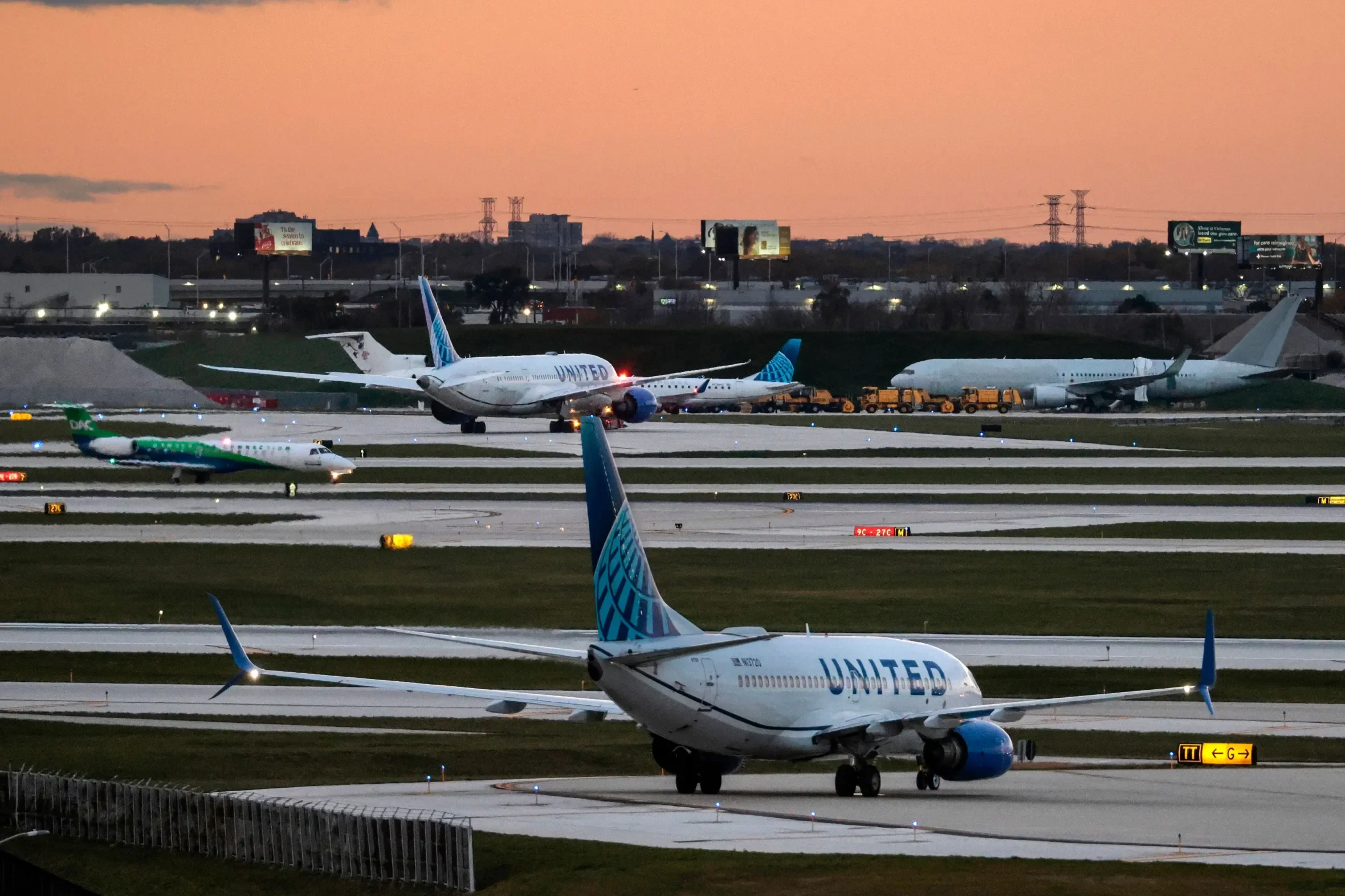
Commercial aircraft at Chicago O’Hare International Airport. Airlines depend on the federal air traffic system to operate, even as passengers remain the largest direct source of revenue for the trust fund that supports it.
Transportation Secretary Sean Duffy went into Friday asking Congress for $30.1 billion to upgrade U.S. airports and air traffic infrastructure, and by Friday night, after a communications failure forced the FAA to stop departures nationwide for nearly five hours, he wanted $50 billion.
“This is an emergency,” Duffy told reporters after the airspace reopened. He described aging telecommunications equipment, leaking control towers and obsolete hardware, then told Congress to provide emergency funding before the end of the year. The earlier $30.1 billion proposal had at least been divided into identifiable pieces: $10.1 billion for air traffic control modernization, $2 billion for towers and $18 billion for airport projects, while Duffy did not provide a comparable public breakdown explaining the additional $19.9 billion he demanded hours later.
There is little dispute that the FAA needs substantial investment, and the problem is old enough that calling it an emergency raises another question. The federal government has been trying to modernize air traffic control since the 1980s, billions have already been spent, Congress appropriated another $12.5 billion last year, airline passengers already pay dedicated aviation taxes every time they fly, and commercial airlines depend on federal air traffic infrastructure for the basic operation of their businesses.
Friday therefore raises a different set of questions from the ones being asked at the White House briefing. How did infrastructure essential to nearly every commercial flight in the United States remain this fragile after more than four decades of modernization programs? Who has already paid for those programs, and who benefited from the contracts? Why does the financing structure place so much of the burden on passengers and federal appropriations when the airline industry cannot earn revenue without the air traffic system underneath it? And before Congress moves another $50 billion, what would actually be purchased with it?
The FAA has been “modernizing” this system since the 1980s
The condition of U.S. air traffic infrastructure was well documented before Friday. The Government Accountability Office says the FAA has struggled to modernize air traffic control systems since the 1980s, and after the nationwide NOTAM outage in 2023, the agency evaluated 138 air traffic control systems and classified 51 as unsustainable and another 54 as potentially unsustainable. Some of the most concerning systems were not expected to be replaced for six to ten years, while several had no modernization project underway at all.
Money has been moving through the system throughout that period. The FAA spent more than $14 billion on NextGen between fiscal years 2007 and 2022, and GAO estimated that the combined federal and industry cost of completing NextGen would reach at least $35 billion through 2030. Progress was uneven enough that some investments took more than six years simply to establish cost, schedule and performance baselines, while FAA acquisition oversight remained inconsistent.
Congress provided another $12.5 billion in 2025 for air traffic modernization and staffing, with roughly $9 billion supporting the first phase of the FAA's current Brand New Air Traffic Control System program. FAA estimated in June that the system-modernization portion of phase one would cost $10.6 billion, and phase two is expected to require another $10.2 billion for automation systems, although GAO reported in September that FAA still lacked a reliable lifecycle cost estimate and detailed integrated master schedule for the overall effort.
GAO agreed that the modernization needs to happen faster and also warned that speed was introducing additional risk because the agency was accelerating work without the planning tools normally used to understand the eventual cost, sequence and interaction of projects. Friday's outage occurred during exactly this period of accelerated conversion.
Officials initially traced the communications failure to work being performed by contractor L3Harris as old copper telecommunications lines were being replaced with fiber, and a newly installed router appears to have flooded other equipment with connection attempts, destabilizing communications and radar information across 17 of the FAA's 22 en route centers. The investigation has not yet established whether the underlying cause was faulty equipment, configuration or installation error.
That does not make modernization unnecessary, but it does mean the condition of the existing system cannot by itself explain Friday's failure. The government was already spending money to repair the system, a private contractor was actively performing that repair, and the work itself appears to have been involved in the disruption.
Duffy nevertheless moved almost immediately from the outage to a much larger funding demand, and the relevant accounting cannot begin with Friday.
Passengers already fund most of the FAA
The FAA is not financed solely through ordinary federal tax revenue, and the United States created the Airport and Airway Trust Fund in 1970 specifically to finance aviation infrastructure and the national airspace system.
Its money comes primarily from aviation excise taxes. Domestic airline tickets carry a 7.5 percent federal tax, while passengers also pay a per-segment charge, taxes on international arrivals and departures and taxes connected to frequent-flier awards. Cargo transportation is taxed at 6.25 percent, commercial aviation fuel carries a 4.3-cent-per-gallon federal tax, and general aviation fuel is taxed at higher rates. Passenger transportation is the largest source of Trust Fund revenue.
The Trust Fund supplied 94 percent of FAA funding in fiscal year 2024 and ended fiscal year 2025 with a $21.8 billion cash balance, although that balance includes money subject to existing appropriations and obligations and should not be read as $21.8 billion freely available for new projects. Treasury expected the fund to collect another $21.3 billion in aviation excise taxes during fiscal year 2026.
People flying commercially are therefore already financing the infrastructure through which they fly, and there is a less obvious problem inside that tax structure. Airlines have increasingly moved revenue outside the base ticket price into baggage charges, seat-selection charges and other ancillary fees, many of which are not subject to the 7.5 percent passenger ticket tax. The Congressional Research Service found that airlines collected approximately $7.27 billion in baggage fees in 2024, and if those fees had been included in the ticket-tax base, the Airport and Airway Trust Fund would have collected more than $545 million from baggage fees alone.
The financing relationship has changed as airlines have changed how they charge passengers, allowing a larger portion of what customers pay for flying to move through revenue categories that do not contribute to the aviation trust fund at the same rate as the ticket itself. That loss does not make the infrastructure cost disappear.
Airlines rely on public infrastructure they are not directly charged to use
Commercial airlines do contribute to the aviation system. They pay fuel taxes, cargo operations are taxed, airlines have purchased equipment required for FAA modernization, and carriers bear substantial operational costs when the airspace fails, as they did Friday.
The relationship is still different from that of a passenger. A passenger uses the national airspace system because they purchased a flight, while an airline uses it as productive infrastructure, and the carrier's fleet, schedules, hubs, cargo operations, route network and ability to sell tickets all depend on continuous access to federally managed airspace. When the FAA stopped departures Friday, the underlying commercial activity stopped with it.
That dependency is easy to see during a failure and much less visible in the financing model. The United States could structure air navigation financing differently, and other countries already do.
NAV CANADA recovers the cost of Canadian civil air navigation services through charges billed to its customers, which include airlines, cargo operators, charter companies, air taxis, helicopters and business aviation. En route charges are calculated partly from aircraft weight and distance flown, while terminal charges are assessed on departures and also account for aircraft weight. Passengers are not directly billed by NAV CANADA, although airlines can incorporate their costs into fares.
Europe uses a related model. EUROCONTROL bills aircraft operators route charges for flights through participating airspace, and the charge incorporates distance flown, aircraft weight and a national unit rate. In 2025, its system processed roughly 11 million flight messages and billed €11.8 billion in route charges, with the money financing air navigation services and infrastructure across participating states.
Those systems do not prevent airlines from passing operating costs through to customers, but they do make the airspace user itself the entity directly assessed for the service, and the amount can reflect how much capacity an aircraft uses.
The United States has made a different distributional choice. Its largest aviation revenue stream is attached to passenger transportation, while direct commercial-airline contributions through aviation fuel taxes are comparatively modest, and an airline flying a large aircraft through hundreds or thousands of miles of controlled airspace does not receive an FAA navigation bill comparable to the one an operator would receive from NAV CANADA or EUROCONTROL.
That makes Duffy's $50 billion request partly a question about who carries responsibility for maintaining the conditions that make commercial aviation possible. If an airline cannot operate without federal controllers, communications networks, radar, navigation systems, airports and safety infrastructure, the degree to which the industry's direct financial responsibility should track that dependence is a legitimate part of the funding debate, and Congress does not have to accept the current allocation simply because it has existed for decades.
DOT seized an opportunity to demand $50B
Duffy's request also deserves scrutiny on its own terms. Earlier Friday, the White House and Department of Transportation were seeking $30.1 billion, and the administration had been pursuing roughly $30 billion for months; Duffy publicly backed the Modern Skies Act in September. Friday evening, after the ground stop, he said he wanted $50 billion instead.
Duffy described the need broadly: new hardware, software and telecommunications, new control towers and investment in airports. He repeatedly invoked the disruption that had just occurred and called for the money to be provided through emergency funding, while at the same press conference the investigation into the outage was still preliminary.
The public explanation never reconciled those numbers. The earlier proposal had specific allocations, while the later demand added almost $20 billion within hours without a similarly detailed account of which projects had changed, what new information produced the increase, or how the additional money would be distributed.
The outage did not reveal that the FAA had old infrastructure; Congress, FAA, GAO and the airline industry already knew that. It revealed that one of the systems failed on Friday, which may strengthen the political case for funding repairs but does not explain the size or structure of a new appropriation.
Congress should be able to separate the urgency of fixing the system from the urgency of approving a particular dollar figure, and GAO's September warning makes that especially relevant. The current modernization program still lacks the reliable lifecycle cost estimate and detailed master schedule needed to understand how its projects fit together, and more money moving through the same planning and procurement structure does not resolve those weaknesses on its own.
An FAA contractor gave money to Duffy’s son-in-law before winning a contract worth up to $875.95M
Large federal modernization programs move public money into private companies, and Friday's immediate failure involved L3Harris, which is performing the copper-to-fiber telecommunications conversion. Other portions of the FAA overhaul involve different contractors, including newer technology companies that may become increasingly important as the agency replaces legacy systems.
One of those relationships already warrants scrutiny. On March 31, the political action committee for Air Space Intelligence gave $2,500 to the congressional campaign of Michael Alfonso, Duffy's son-in-law, and the contribution appears in Alfonso's Federal Election Commission filing. Three months later, the FAA awarded Air Space Intelligence a contract to supply its new Flow Management Data and Services platform, with an initial obligated value of about $23.3 million and a potential value of $875.95 million through 2038.
The contribution does not establish that it influenced the contract, but federal records do establish the relationship, and it sits inside a broader pattern ProPublica documented in March: Alfonso's campaign received contributions from lobbyists, executives and political committees connected to industries regulated or funded by Duffy's department. Duffy has also appeared at events supporting Alfonso, while a DOT spokesperson told ProPublica that Duffy attends campaign events in his personal capacity and that regulatory decisions are guided by career safety professionals, law and facts.
Air Space Intelligence's system became another point of controversy in October when more than two dozen lawmakers asked the FAA to pause its use around Washington until the agency provided more information about safety testing, evaluation and training, although the system does not control aircraft and has not been identified as a cause of Friday's outage.
The relevance here is procurement accountability. If Congress is about to authorize tens of billions of additional dollars through an accelerated modernization program, the relationships among the officials directing the program, the contractors receiving the money and the political networks around those officials become more important, especially because emergency funding can compress normal decision time while GAO is already warning that FAA modernization is moving faster than its cost and scheduling controls.
There are basic questions that should have public answers. Did Duffy participate in the Air Space Intelligence procurement, and did he seek ethics guidance or recuse himself? What portions of the proposed $50 billion would be competitively bid, which existing contracts would expand, and how much would move through sole-source modifications or accelerated procurement? What independent oversight would follow the money after Congress appropriates it?
Those questions do not depend on proving a quid pro quo. Public infrastructure has to be governed in a way that makes the relationships around public money visible enough that people do not have to trust the officials and contractors involved to police themselves.
Passengers absorb the cost when the system fails
Friday's disruption made the costs of air traffic infrastructure briefly impossible to ignore. Flights stopped, tens of thousands of passengers were stranded, airlines spent the weekend repositioning aircraft and crews, and by Saturday thousands more flights had been canceled as the system worked through the disruption.
The public encounter with the financing system happens differently. Passengers pay aviation taxes when they purchase tickets, they pay more through airfare when airlines pass operating costs downstream, and they may pay general federal taxes into emergency appropriations. When equipment fails, they absorb missed work, hotels, meals and disrupted travel, while airlines are generally not responsible for compensation when the underlying failure belongs to the FAA.
What is much harder for the public to see is the long period between those failures: procurement decisions, delayed upgrades, incomplete oversight recommendations, contractor performance, congressional appropriations and the gradual deterioration that eventually becomes an emergency. That is where the accountability problem sits.
An air traffic control system is infrastructure precisely because nobody using it can individually replace it. Airlines cannot create separate national airspace systems for their own fleets, passengers cannot shop for a different FAA when one system deteriorates, and the federal government therefore carries responsibility for maintaining a relationship that commercial aviation and the traveling public have no practical way to exit.
The airline industry's dependence on that relationship should be part of how its costs are distributed. The FAA has needed modernization for decades, passengers have been paying into a dedicated aviation fund throughout that period, Congress has repeatedly appropriated money, and private companies have repeatedly received modernization contracts. The system still reached Friday with more than three-quarters of its air traffic control systems classified as unsustainable or potentially unsustainable as recently as 2024.
Before another $50 billion moves through the same structure, the government owes the public more than an explanation of why modern air traffic control is necessary. It owes an account of why the money already committed did not keep the system continuously modernized, why so much of the financing burden remains attached to passengers rather than directly to the commercial operators whose businesses require the system, what changed between the $30.1 billion request Friday morning and the $50 billion demand Friday night, and how the next round of contracts will be kept separate from the political relationships surrounding the officials awarding them.
What I'm watching now
The first thing to watch is the actual $50 billion proposal when it reaches Congress. Duffy said Saturday that he intended to make the formal request Monday, and the allocation will show whether the extra money is concentrated on the equipment implicated in Friday's outage, expands the broader airport package already proposed, accelerates existing contractor work, or creates new programs that were not part of the $30.1 billion request.
The funding source matters too. Money drawn from the Airport and Airway Trust Fund comes from a different relationship than a large emergency appropriation from the general fund, and Congress could also change the revenue structure rather than treating the current mix of passenger taxes, fuel taxes and general appropriations as fixed. Tax treatment of ancillary airline revenue, direct carrier assessments and flight-based air navigation charges are all places where the distribution of cost could change.
The FAA and L3Harris investigation should establish why the router installation was able to affect 17 of 22 en route centers, and that finding will help distinguish the cost of replacing old equipment from the cost of managing the modernization itself. If the failure arose from the transition process, that belongs in congressional scrutiny of a program GAO already warned is being accelerated without sufficiently developed cost and schedule planning.
Any additional appropriations should also make the contractor network more visible. Air Space Intelligence's contribution to Alfonso, the company's subsequent FAA award and the wider transportation-industry fundraising documented around Duffy's son-in-law are relationships that can be examined without assuming what they mean, and recusal records, procurement scoring, contract modifications, lobbying disclosures and the eventual recipients of emergency funding would provide considerably more information than political assurances about integrity.
Current Risk Assessment · November 15, 2026
Current assessment: The United States has an urgent air traffic modernization problem embedded inside a longer governance and financing problem. FAA infrastructure has deteriorated across decades of incomplete modernization despite substantial existing appropriations and a dedicated aviation revenue system, and Friday's nationwide ground stop has accelerated pressure for another $50 billion before the government has publicly explained the increase from its earlier $30.1 billion request, completed the failure investigation, or resolved GAO's concerns about cost and schedule planning. Passengers remain the largest direct source of aviation trust-fund revenue even though commercial operators depend on the same infrastructure for their ability to earn revenue.
Expected if this assessment holds: Congress will face pressure to approve substantial additional funding quickly while disputes grow over project prioritization, contractor oversight and the source of the money. Emergency financing could accelerate modernization, but weak cost planning or insufficient procurement oversight would leave the same accountability relationships in place even as more money enters the system.
Would weaken the assessment: A detailed and independently reviewable $50 billion proposal tied to a reliable lifecycle cost estimate and master schedule; clear evidence that prior modernization spending produced durable capacity consistent with its costs; stronger procurement and conflict-of-interest controls; and a financing structure that more transparently allocates infrastructure costs among passengers, commercial airlines, cargo operators, general aviation and the broader public according to how they use and benefit from the system.
Status: Strained, with modernization urgency and funding accountability unresolved.
Sources
U.S. Government Accountability Office — Air Traffic Control Systems: Ambitious New Modernization Effort Needs to Improve Cost and Schedule Planning, September 14, 2026
Federal Aviation Administration — Airport & Airway Trust Fund
Congressional Research Service — Federal Civil Aviation Programs: Background and Issues for Congress, June 27, 2025
Reuters — White House urges Congress to provide $30.1 billion for aviation reform, November 13, 2026
Reuters — US aviation shutdown blamed on L3 Harris installed router, November 14, 2026
Roll Call Factba.se — Press Briefing: Markwayne Mullin & Sean Duffy Discuss the FAA Ground Stop, November 13, 2026
U.S. Department of Transportation — Trump’s Transportation Secretary Sean P. Duffy, Modern Skies Coalition Applaud Senator Schmitt’s $30 Billion Modern Skies Act, September 28, 2026
Federal Election Commission — Alfonso for Congress, April 15 Quarterly Report, April 15, 2026
USAspending.gov — Air Space Intelligence, Inc. — FAA Flow Management Data and Services contract
ProPublica — Transportation Lobbyists Have Donated Thousands to Sean Duffy’s Son-in-Law as He Runs for Congress, March 18, 2026
Reuters — Lawmakers ask FAA to pause use of new AI tool in DC-area flight management, October 13, 2026
NAV CANADA — Service Charges
EUROCONTROL — Customer Guide to Charges, April 3, 2026