Why Is Europe Preparing Its Citizens for Disruption?
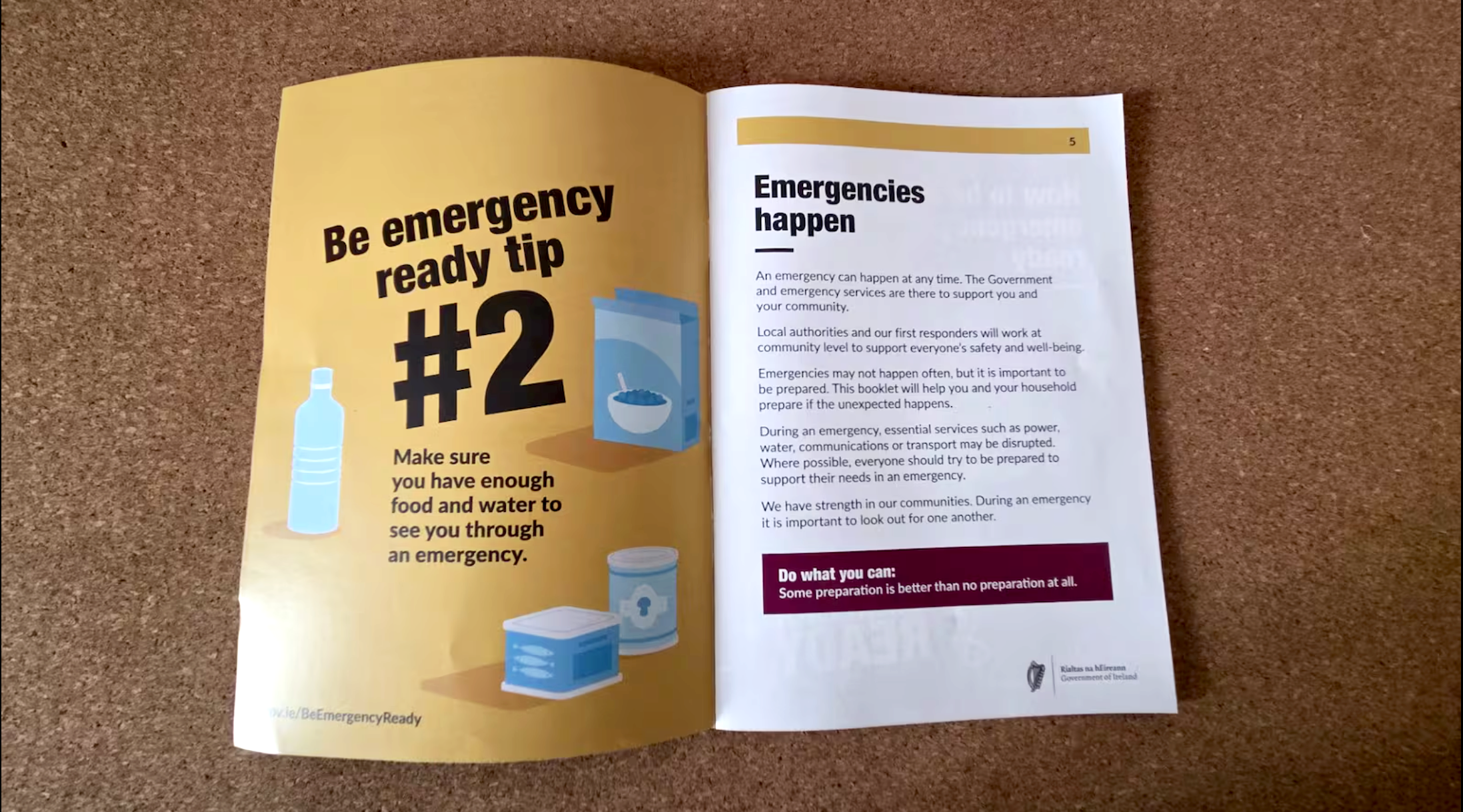
The Be Emergency Ready booklet contains essential information. Photograph: Jessica Doyle/The Irish Times
Beginning today, approximately 2.2 million households in Ireland are being sent a government booklet explaining how to prepare for emergencies. Be Emergency Ready recommends keeping water, food, medication, a battery-operated radio, flashlights and other supplies available in case electricity, communications or other basic services are interrupted. Ireland’s Department of Defence has said the program was influenced in part by Storm Éowyn, which left 768,000 households without power in January 2025.
Ireland joins several European countries that have moved civilian preparedness further into ordinary household planning over the past two years. The Netherlands distributed emergency-preparedness booklets to more than 8.5 million households between November 2025 and January 2026, advising residents to be capable of managing independently for the first 72 hours of a major emergency. Dutch guidance covers power failure, digital attack, flooding and other events that could interrupt access to electricity, water, communications or public assistance.
The European Union has adopted the same 72-hour benchmark. Its Preparedness Union Strategy, introduced in March 2025, calls for guidelines enabling households to remain self-sufficient for at least three days, along with stronger early-warning systems, stockpiling, civil-military planning, public-private emergency protocols and regular preparedness exercises.
The household campaigns are developing alongside changes in military planning, healthcare, infrastructure protection and civil defense. Germany is planning for civilian hospitals to absorb large numbers of military casualties in a NATO conflict. Finland has expanded public guidance for drone attacks and proposed new authorities to protect undersea infrastructure and counter unmanned systems. Switzerland adopted a new national security strategy on September 18 centered on resilience, protection and defense capacity. Poland has been running civil-defense exercises involving drones, evacuations and interruptions to drinking water while also activating real air-threat alerts during Russian attacks on Ukraine.
These programs were not created at the same time and are not responses to a single threat. Their overlap is in the kinds of failures governments are preparing civilian systems to absorb: electricity outages, communications failures, disrupted transport, cyberattacks, infrastructure sabotage, military spillover and periods in which normal government services cannot immediately reach everyone.
Households are being asked to carry the first several days
The Dutch preparedness campaign gives residents a specific time horizon: 72 hours. Households are advised to store water, food and necessary medication, maintain ways to receive information without internet access and prepare for interruptions to services they normally assume will remain continuously available. The program treats household preparedness as a way to reduce immediate dependence on emergency services while authorities respond to the broader disruption.
The EU’s Preparedness Union Strategy extends that approach across member states. Alongside the 72-hour household standard, the strategy calls for stronger preparedness in schools, improved warning systems, emergency protocols between governments and private companies, greater stockpiling capacity and comprehensive civil-military arrangements. It also calls for regular EU exercises and closer preparedness coordination with NATO.
Ireland’s new booklet is broader than military preparedness. It addresses severe weather, prolonged power failure and other emergencies, and the government has explicitly connected the initiative to lessons from Storm Éowyn. The distribution still places Ireland within a wider European shift toward asking households to maintain a small amount of independent operating capacity during disruptions to centralized systems.
The Netherlands and Ireland are therefore arriving at a similar household model through somewhat different threat environments. Residents are being asked to assume that electricity, water, communications or government assistance may occasionally become unavailable for long enough that the first stage of response has to happen inside the household.
Germany is planning civilian healthcare into a NATO conflict
Germany’s planning extends this model into healthcare. Bundeswehr contingency planning for a major conflict on NATO’s eastern flank uses an assumption of as many as 1,000 wounded military personnel arriving for treatment each day. Germany’s location would make it a transit point for troops and supplies moving east and for casualties moving west, while military medical services would depend heavily on civilian hospitals.
The 1,000-per-day figure is a planning assumption rather than a prediction that Germany expects that number of casualties. It determines the scale of hospital capacity, medical transport, pharmaceutical supply chains and coordination that would be required under a severe conflict scenario. Bundeswehr discussions this year have continued to focus on civilian-military healthcare structures, secure medical supply chains and the ability to treat large numbers of casualties during crisis or war.
The planning expands the resources relevant to military readiness beyond military hospitals. Civilian beds, medical staff, medicines, transport networks and supply systems become necessary to sustain operations if military demand rises sharply at the same time civilian healthcare continues to function.
Switzerland has formally expanded its security planning
Switzerland adopted its 2026 Security Policy Strategy on September 18. The Federal Council identified three priorities: strengthening resilience, improving resistance and protection capabilities, and strengthening defense capacity. Implementation of the strategy’s 10 objectives and 46 measures had already begun by the time it was formally approved.
The strategy describes Russia’s war against Ukraine, hybrid threats and critical dependencies as part of a substantially worse European security environment. It includes cyberattacks, espionage, sabotage, long-range weapons and other threats alongside conventional military attack, and it calls for coordination among federal and cantonal authorities as well as the private sector, academia, associations and the public where necessary.
Switzerland also states that a direct armed attack on the country remains unlikely in the foreseeable future. Its government is nevertheless expanding preparations for long-range attacks, hybrid activity and disruptions that could affect civilian infrastructure or public safety. The strategy therefore provides a clear example of preparedness increasing without a public assessment that conventional war on Swiss territory is likely.
Finland is changing both public guidance and legal authority
Finland added instructions for airborne threats to its national preparedness guide in June. The guidance explains how authorities would issue warnings, how civilians should respond to drone threats and where they should take shelter. It explicitly notes that an airborne threat could include a drone carrying explosives.
On September 10, the Finnish government submitted legislation that would give the Border Guard new responsibilities for protecting critical underwater infrastructure and additional powers to intercept unmanned vehicles. The proposal covers Finland’s territorial waters and exclusive economic zone and is intended to improve the Border Guard’s ability to respond to emerging security situations.
Those measures place civilian infrastructure, maritime security and drone defense inside the same preparedness framework. They also move beyond public information campaigns by changing the authority available to state institutions before a disruption occurs.
Poland is exercising scenarios it is also encountering in practice
Poland conducted a two-day civil-defense exercise called DRON-26 on September 9 and 10. The scenario included unidentified drones crashing in Mazovia, a large forest fire, disruption to drinking-water access and the evacuation of civilians. Fire services, police, territorial defense forces and regional authorities participated in the exercise.
Poland has also been testing warning sirens across multiple districts throughout September. At the same time, the government’s RCB alert system has issued real warnings during Russian aerial attacks on Ukraine. On September 17, residents received messages stating that a Russian attack was underway in Ukraine, Polish military aircraft were operating, and further communications should be monitored. Polish and allied aircraft have also been placed on preventive alert during major Russian strikes, including on September 19, when no violation of Polish airspace was ultimately recorded.
The same warning and response systems are therefore being used in exercises and activated during actual regional military events. Poland’s September activity includes both planned tests of civilian response and operational precautions prompted by attacks immediately across its border.
Drone incidents have increased the operational burden on NATO states
On September 14, an Italian fighter operating under NATO’s Baltic mission shot down a Russian-made drone after it entered Lithuanian airspace from Belarus. Initial reporting identified it as a suspected Geran-2 military drone. Lithuanian investigators later identified the aircraft as a Gerbera-type drone, and President Gitanas Nausėda said it was probably intended for Ukraine rather than Lithuania. Investigators continued examining its electronics and did not establish that Lithuania had been its intended target.
The later assessment limits what can be inferred about Russian intent, but the incident still required an operational NATO interception inside allied airspace. It also occurred during a period in which European governments have reported additional drone activity, sabotage concerns and other forms of hybrid disruption.
At NATO’s Military Committee meeting in Copenhagen on September 19, committee chair Admiral Giuseppe Cavo Dragone referred publicly to recent Russian airspace violations, drone incidents and hybrid activities and said they had been testing allied responses. The meeting focused on readiness, multi-domain operations, capability targets and the ability of defense industry to deliver equipment at greater speed and scale.
France has also moved to strengthen infrastructure protection. President Emmanuel Macron directed his government this month to prepare measures protecting sensitive infrastructure and defense sites against drones, cyberattacks and other hybrid threats.
What the public record shows
Public documents do not establish whether European governments possess classified intelligence pointing to a specific future Russian attack. They show governments making concrete preparations for severe disruption through legislation, exercises, infrastructure protection, hospital planning, warning systems and household preparedness.
The programs also began on different timelines. The EU Preparedness Union Strategy dates to March 2025. The Dutch household campaign began in November 2025. Germany published its 1,000-casualty planning assumption last year. Switzerland’s strategy went through a consultation process before formal approval this month. Ireland has linked its own program in part to the experience of a major weather event.
The public explanations also cover more than Russia. Flooding, cyberattack, prolonged power failure, sabotage, extreme weather, infrastructure damage and military conflict appear across national and EU preparedness documents. Switzerland explicitly describes direct armed attack as unlikely in the foreseeable future while still preparing for long-range weapons and hybrid threats.
The public record cannot show what classified intelligence, if any, sits behind individual decisions. It can show that governments across Europe are committing more resources to circumstances in which civilian systems may be interrupted for hours or days and central authorities may not be able to restore normal service immediately.
Civilian continuity is becoming part of security planning
The programs differ in scope, but they increasingly allocate responsibility across more parts of society. Households are asked to maintain basic supplies. Hospitals are incorporated into casualty planning. Border agencies receive powers to protect infrastructure. Municipalities practice evacuations and warning procedures. Governments are testing how civilian and military institutions would operate together under conditions that affect several systems at once.
A large disruption can produce secondary problems that extend beyond its original source. Loss of electricity affects communications, payment systems and fuel distribution. Transport disruption can interfere with medical supply chains. Cyberattack or sabotage can increase demand for emergency services while reducing the systems those services normally rely on. The 72-hour household model reduces immediate demand on centralized response by moving a small amount of continuity capacity to households.
Germany’s healthcare planning applies the same principle at an institutional scale. Civilian hospitals would absorb demand that military medical infrastructure could not handle alone. Finland’s proposed maritime authorities distribute infrastructure protection across agencies before an incident develops. Poland’s civil-defense exercises test the ability of separate services to operate together when a drone event produces fire, water disruption and evacuation requirements.
The preparations do not indicate that every government is planning for the same event. They indicate a broader reduction in the assumption that normal civilian systems will remain continuously available during a serious crisis.
What I’m watching now
The first indicator is whether household preparedness develops into more formal requirements for essential services. The EU has already called for minimum preparedness standards, 72-hour household self-sufficiency and stronger civil-military coordination. Additional national requirements for hospitals, telecommunications providers, schools, utilities or municipalities would extend the same planning assumptions further into civilian infrastructure.
Spending on physical capacity will provide another measure. Emergency stockpiles, shelter capacity, backup communications, redundant power, medical reserves and infrastructure hardening require sustained investment. Announced preparedness becomes more consequential when it changes what governments and public institutions can actually operate during an extended disruption.
Civil-military exercises will also show how far the integration has progressed. Germany is already planning civilian healthcare into a large-scale NATO conflict scenario, while the EU calls for regular civil-military exercises. Expansion into rail, ports, logistics, telecommunications and energy would increase the amount of civilian capacity incorporated directly into security planning.
The frequency of real activations will be equally important. Poland has repeatedly raised air-defense readiness during Russian attacks on Ukraine, and NATO has now used force against an unmanned aircraft inside Lithuanian airspace. Additional incidents would give governments more operational experience with systems that until recently were exercised primarily through planning scenarios.
Current Risk Assessment · September 21, 2026
Current assessment: Civilian preparedness is becoming more deeply integrated into European security planning. Household self-sufficiency programs, hospital contingency planning, infrastructure protection, drone-response powers, warning exercises and national security strategies are expanding across countries with different alliance relationships and threat profiles. The public record does not establish whether classified intelligence points to a specific forthcoming attack.
Expected if this assessment holds: European governments should continue increasing civil-defense capacity, infrastructure protection, emergency stockpiles, public warning systems and coordination between civilian and military institutions. More healthcare, transport, telecommunications, energy and local-government systems are likely to appear in contingency planning and exercises designed around prolonged interruption of ordinary services.
Would weaken the assessment: Reduced civil-defense investment, failure to implement recently announced measures, fewer operational responses to cross-border drone or sabotage incidents, lower official threat assessments, or evidence that the current programs remain temporary national initiatives rather than becoming durable parts of European security planning.
Status: Elevated, with civilian preparedness expanding.
Sources
European Commission, EU Preparedness Union Strategy, March 2025. Preparedness Union Strategy
Swiss Federal Council, Comprehensive approach to security: Federal Council adopts the 2026 Security Policy Strategy, September 18, 2026. Swiss Security Policy Strategy
Bundeswehr, Healthcare provision in a defense scenario, November 5, 2025, and Healthcare in crisis and war, May 13, 2026. Bundeswehr healthcare planning
Finnish Government, Instructions on staying safe during threats from the air, June 30, 2026, and Border Guard preparedness and counter-drone authorities, September 10, 2026. Finnish airborne-threat guidance
Netherlands NCTV, Prepare for an Emergency, November 17, 2025. Dutch emergency-preparedness campaign
The Irish Times, Government emergency booklet distribution, September 17, 2026. Ireland’s Be Emergency Ready distribution
Polish government, DRON-26 civil-defense exercise, September 10, 2026. DRON-26 exercise
NATO, Military Committee Conference in Copenhagen, September 19, 2026. NATO Military Committee statement